
Demystifying the Biofield
by Connecting the Dots of Science We Already Understand

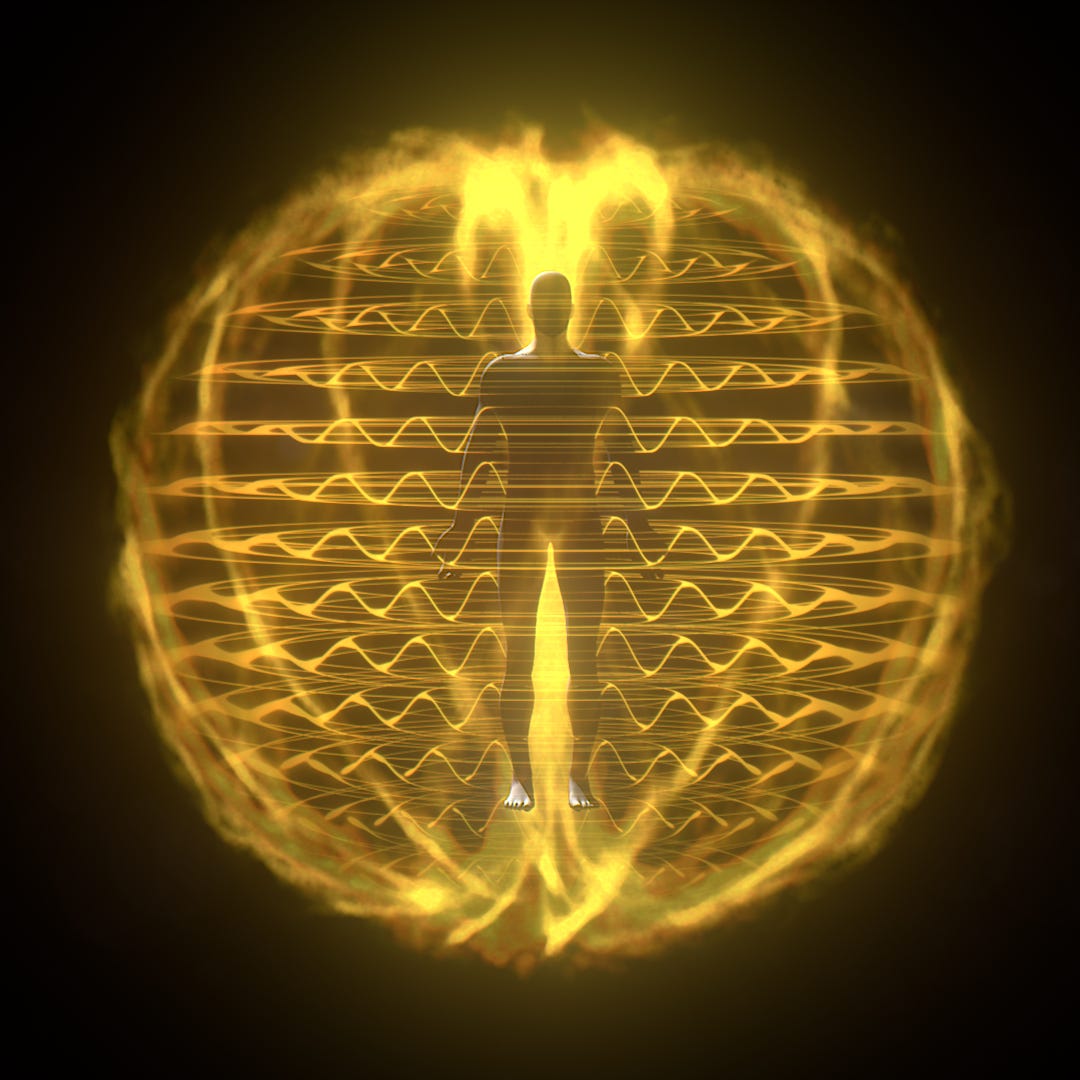
The word biofield can sound mysterious, largely because most of us were taught to think of the human body primarily as a chemical machine. We learned about hormones, neurotransmitters, enzymes, organs and biochemical reactions, while the electrical nature of the body was usually treated as a collection of specialized facts: the heart is electrical, the brain produces electrical waves, nerves conduct electrical impulses and muscles contract in response to electrical signals. Rarely were we invited to step back and consider what all of this means when taken together.
The logical conclusion is surprisingly straightforward: the human body is an electrically active organism, and wherever electrical currents flow, magnetic fields arise around them. The currents within the body are carried primarily by ions rather than by electrons moving through metal wires, but the basic principle of electromagnetism is the same. The magnetic activity generated by the heart can be measured through magnetocardiography, while the much smaller magnetic fields produced by neuronal activity can be measured through magnetoencephalography. These are established medical and research technologies, not speculative ideas.
This gives us the first essential step in understanding the biofield: a living human body generates a complex, constantly changing electromagnetic environment both within and around itself. Calling this environment a biofield does not require belief in a mysterious substance or supernatural energy. A field is simply a region in which an influence can be detected. The Earth has a magnetic field, a radio transmitter produces an electromagnetic field, and the electrical activity of the human body produces associated fields as well.
The Body’s Electricity Is Not Merely a Byproduct
It would be easy to assume that the body’s electrical activity is simply exhaust from its biochemical machinery, but research increasingly shows that electrical patterns play an instructive role in biology. Cells maintain voltages across their membranes. Groups of cells form bioelectrical networks through ion channels and gap junctions. Electrical gradients help regulate cell migration, development, tissue repair and regeneration.
When the skin is wounded, for example, the disruption of the epithelial layer immediately creates an endogenous electrical field around the injury. Cells detect this field and use it as a directional cue, migrating toward the wound. Experimental manipulation of these fields can change the direction of cell movement and affect healing. Bioelectric signaling also participates in larger-scale decisions about growth, form and anatomical patterning.
This is an important development in biology because it shows that the body is organized by more than chemistry and genes. There are also spatial patterns of voltage, charge and ion flow that carry information between cells and across tissues. Researcher Michael Levin and others have proposed that these bioelectrical networks can hold non-genetic information about anatomical pattern—information that helps living systems determine what structures belong where and what must be repaired after injury.
The biofield, then, can be approached as the larger, dynamic pattern created by all of this electrical activity: billions of charged cells, rhythmic organs, ion currents, voltage gradients and communication networks operating together rather than as isolated parts.
Fields, Patterns and Information
We already accept that physical patterns can carry information. Magnetic technology provides a familiar example. In magnetic memory, information is encoded through organized patterns of magnetization. One orientation can represent a zero, while another represents a one. By changing the magnetic pattern, information can be written, stored, altered and retrieved.
This does not mean that the human magnetic field stores autobiographical memories in exactly the way a computer hard drive stores photographs. That comparison would go beyond the evidence. What the technology demonstrates is the more fundamental principle that organized electromagnetic states can embody information. Pattern is information when the pattern influences what a system does next.
Biology offers an even more direct comparison. Patterns of cellular voltage can influence whether cells divide, migrate, differentiate, repair tissue or participate in the creation of a particular anatomical structure. The information is not necessarily held in one molecule or one location. It exists in the relationships among many electrically active parts of the system.
This gives us a reasonable way to think about the human biofield: not as an empty aura surrounding the body, but as the spatial and temporal organization of the body’s electrical, magnetic, mechanical and rhythmic activity. It is a continuously updated pattern that generates and is generated by the organism as a whole.
The Body Is an Orchestra of Oscillations
The body does not maintain this organization in a static way. It pulses, cycles and oscillates. The heart beats. The lungs expand and contract. The brain produces rhythmic electrical activity. Blood pressure rises and falls with each cardiac cycle. The digestive system generates slow electrical waves. Hormones follow daily and monthly rhythms. Cells contain molecular clocks and repeating cycles of activity.
In other words, the body is not only electromagnetic; it is oscillatory. It is composed of countless rhythms interacting with other rhythms.
Whenever oscillations share a system, the principles of wave physics become relevant. Waves can overlap, reinforce each other, partially cancel each other or create complex interference patterns. When waves of compatible frequency travel in opposing directions within a bounded region, they can form standing waves containing areas of relative stillness, called nodes, and areas of greater activity, called antinodes. Musical instruments, air columns, vibrating membranes and electromagnetic resonators all demonstrate these principles.
It would be premature to state that the entire external human magnetic field has already been shown to form one stable, measurable standing-wave structure. That specific claim has not been established. What we can confidently say is that the body contains many overlapping electrical, mechanical, fluid and acoustic oscillations, and that living tissues are capable of supporting resonance, wave propagation and interference.
This distinction matters because it allows the scientific argument to remain strong. We do not have to claim that every feature of the biofield has already been measured. We need only recognize that an oscillating organism will naturally generate spatial patterns of constructive and destructive interference, changing amplitude, phase relationships, nodes, resonances and areas of greater or lesser mechanical response.
A Tuning Fork Is Both a Signal and a Probe
A tuning fork is unusually useful in such a system because it produces a relatively stable, narrow-band frequency. When struck, its tines oscillate at a predictable rate, setting the surrounding air into alternating regions of compression and rarefaction. This is sound: an organized mechanical pressure wave moving through matter.
As that wave travels, it meets other surfaces, tissues and waves. Some of its energy is absorbed, some reflected, some scattered and some transmitted. The outgoing wave can overlap with reflected waves, producing constructive and destructive interference. Movement of either the fork or the listener introduces additional changes in amplitude, phase, direction and perceived tone.
This is not unique to Biofield Tuning. Science and technology routinely uses waves to learn about systems that cannot be examined directly. Sonar sends sound into an environment and analyzes what returns. Ultrasound detects differences in tissue by measuring how acoustic energy is reflected and transmitted. Spectroscopy applies known frequencies to matter and observes its response. Radar sends electromagnetic waves outward and detects how their pattern changes after encountering an object.
The underlying logic is consistent: introduce a known signal into a system, observe what happens to that signal and use the change to infer something about the system.
Biofield Tuning applies a similar principle in a human setting. The tuning fork provides the known signal. As it is moved through the space around the body, variations may be heard in its volume, clarity, rhythm, overtones or texture. These changes can be treated as feedback from the combined acoustic environment formed by the fork, the room, the person, the practitioner and the movement between them.
What has not yet been scientifically established (although has been clinically observed for decades) is that every audible change in the fork is caused specifically by a distortion in the person’s external magnetic field. Acoustic reflection, absorption, body geometry, practitioner movement, auditory perception and other mechanical factors may all contribute. The change in sound can be observed, but the exact physical variables represented by that change still require carefully controlled measurement.
Sound Does Not Stop at the Skin
Sound is sometimes imagined as something that enters only through the ears, but sound is mechanical energy. Its pressure waves encounter the entire body. They can vibrate the skin, connective tissue, fluids, bones and sensory receptors, particularly when a vibrating fork is placed directly on the body.
Cells are not mechanically inert. They contain mechanosensitive structures that respond to pressure, stretch, vibration and changes in tissue tension. Mechanical forces can open ion channels, alter the cytoskeleton, affect adhesion between cells and initiate biochemical and electrical signaling. This conversion of mechanical force into cellular activity is called mechanotransduction.
Research into audible sound, low-frequency vibration and ultrasound shows that acoustic stimulation can influence mechanosensitive channels, cellular signaling, gene expression and tissue behavior, although the effects depend heavily upon frequency, intensity, duration and the type of cell or tissue being stimulated.
The body also contains piezoelectric materials. Piezoelectricity is the generation of electrical polarization or voltage when certain materials are mechanically stressed. Bone, fascia, and collagen-rich tissues exhibit piezoelectric properties, which means that compression, bending and vibration can generate very small electrical effects within the biological matrix.
This relationship between mechanical stress and electrical signaling has been studied extensively in bone biology and tissue engineering.
This creates a direct bridge between sound and electricity. When acoustic vibration mechanically deforms piezoelectric or mechanosensitive tissue, the result need not remain purely mechanical. It can be converted into changes in electrical potential, ion movement and cellular signaling.
Airborne sound from a tuning fork is relatively gentle, while placing the stem of the fork directly on the body creates much stronger mechanical coupling. In either case, however, the fork is not merely producing a tone that the mind interprets symbolically. It is introducing organized mechanical energy into an electroactive living system.
Resonance: Why Certain Frequencies Produce Greater Responses
Every physical structure has frequencies at which it responds more readily. A playground swing moves higher when it is pushed at the right point in its cycle. A singer can cause a nearby string to vibrate when the sung note matches the string’s resonant frequency. One tuning fork can cause another fork of the same frequency to begin vibrating across a room.
This is resonance: the selective amplification of a response when an external frequency corresponds with one of a system’s natural modes.
A human body is far more complex than a string or a second tuning fork. It does not have one resonant frequency. Different tissues, cavities, bones, membranes, fluids and physiological rhythms respond differently depending upon the frequency, intensity and method of delivery. Nevertheless, the principle remains relevant. A coherent vibration introduced into the body will interact more strongly with some structures and rhythms than with others.
Resonance may help explain why one frequency can feel soothing while another feels irritating, why vibration placed on one part of the skeleton travels to distant locations, and why a tone sometimes produces a pronounced sensation in a particular region of the body. The response is not necessarily evidence of a hidden energy center; it may reveal the mechanical and neurological relationships within the person’s living structure.
Entrainment: How Rhythms Influence Other Rhythms
Entrainment is related to resonance but is not exactly the same. It occurs when oscillating systems interact and gradually synchronize some aspect of their timing. Biological systems demonstrate entrainment continually. The circadian system synchronizes with cycles of light and darkness. Human movement synchronizes with musical rhythm. Neural activity can synchronize with rhythmic features in sound, speech and music.
EEG studies have demonstrated that rhythmic auditory stimulation can influence the timing of ongoing neural oscillations. Brain activity tracks rhythms in speech and music, and carefully controlled rhythmic sounds can produce reliable changes in neural phase and auditory perception.
This does not mean that playing a single frequency automatically forces the brain, heart and every cell into that frequency. Entrainment requires coupling, and the outcome depends on the strength, timing and condition of both systems. Yet the basic principle is established: organized external rhythms can influence the timing and coordination of biological rhythms.
A tuning fork provides a highly coherent rhythm. When that rhythm is introduced through the ears, the skin or the skeleton, it offers the nervous system and tissues a stable reference signal. A disorganized system may begin to organize around that reference - not because the fork overpowers the body, but because coherent systems can provide timing information to less coherent ones.
How Tuning Forks May Modulate the Biofield
From this perspective, tuning forks may influence the biofield through several overlapping pathways.
First, they introduce acoustic and mechanical energy. This energy travels through air, tissue, fluid and bone, creating pressure changes and vibration.
Second, mechanical stimulation activates mechanotransduction. Cells, connective tissue and sensory receptors translate pressure and vibration into electrical and biochemical responses.
Third, strain within piezoelectric tissues such as collagen and bone generates subtle electrical potentials, adding another route by which mechanical vibration can alter the body’s electrical activity.
Fourth, the sound is processed through auditory and somatosensory pathways, influencing attention, muscular tension, emotional state and autonomic regulation. Changes in breathing, muscle tone, heart rhythm and nervous-system activity alter the electrical currents produced by the body.
Finally, the relationship between pressure, electricity, and magnetism in the body is reciprocal. Electric currents do not arise from nowhere; compression, tension, and movement can separate charge and initiate current. In this sense, the squeeze precedes the spark. A tuning fork applied to the body can influence these mechanical and electrical processes, while a fork held in the field may interact with the magnetic rhythms already being expressed there. A change in one part of the system informs the behavior of the others.
This may be the most scientifically defensible way to understand modulation of the biofield. The tuning fork introduces coherent mechanical information into a living electromechanical network. The organism responds through resonance, mechanotransduction, neural processing, piezoelectric effects and entrainment. As charge distribution, ion flow, tissue tension and physiological rhythm change, the electromagnetic pattern generated by the body changes with them.
What Do We Mean by a Distortion?
Within this model, a distortion does not have to be imagined as a dark object floating in an invisible aura. It may be understood as an area in which the system’s normal flow, timing or responsiveness has become less coherent.
Scar tissue changes mechanical conductivity. Chronic muscular tension changes the way vibration travels through tissue. Inflammation alters fluid distribution, cellular activity and electrical properties. Injury changes local signaling. Protective nervous-system patterns affect breathing, posture, heart rhythm and muscle tone. Changes in hydration, fascia, bone density and extracellular matrix will all affect the transmission of mechanical energy.
A distortion may therefore be a complex convergence of altered tension, conductivity, charge distribution, autonomic activity and wave behavior. Such a region may absorb, reflect, scatter or respond to vibration differently from the surrounding system.
The further Biofield Tuning hypothesis - that particular locations in the field reliably correspond with particular ages, emotions or life experiences - is more specific and requires its own body of blinded, reproducible research. It is not presented as proven merely because electromagnetism, resonance and piezoelectricity are proven. However, neither should the absence of that research be used to dismiss the entire possibility before it is properly investigated.
Future research seeks to identify what can be measured: changes in the acoustic spectrum of the fork, distance from the body, physiological changes in the recipient, heart-rate variability, respiration, brain activity, muscle tone, skin conductance and other pre- and post-session markers.
A Model That Follows Known Science
The scientific foundation of the biofield does not depend upon proving that an invisible copy of the body is floating several feet beyond the skin. It begins with facts that are already well established.
The body is electrically active. Electrical activity produces magnetic fields. The body’s magnetic signals can be measured. Bioelectric patterns help regulate cellular behavior, wound healing and anatomical organization. The body consists of interacting oscillators. Waves interfere and create resonant patterns. Sound applies mechanical force. Living tissues convert mechanical force into electrical and biochemical activity. Piezoelectric tissues generate electrical effects when stressed. Rhythmic sound can influence neural timing. Changing the body’s electrical activity necessarily changes the magnetic activity associated with it.
None of these principles is controversial in isolation.
The hypothesis of Biofield Tuning is that they are not isolated. They participate in one continuous, living system, and a coherent acoustic frequency can be used both to investigate that system and to help reorganize it.
The precise mechanism is unlikely to be only magnetic, only acoustic, only neurological or only mechanical. The body does not divide itself into the academic departments through which we study it. Mechanical pressure alters electrical activity. Electrical activity alters chemistry. Chemistry changes tissue tension. Tissue tension changes acoustic transmission. Nervous-system state changes every part of the equation.
The biofield may ultimately prove to be the name we give to this inseparable, system-wide pattern of communication and organization.
Seen this way, tuning the biofield is not an attempt to impose something foreign upon the body. It is the introduction of a clear, stable frequency into a living network that already operates through rhythm, vibration, electricity and information. The fork provides a reference. The body supplies the intelligence. The interaction between them creates the possibility of greater coherence.
This is not a departure from science, but simply what comes into view when the science we already understand is seen as a whole.

Learn more about my 3 decades of exploration and discovery with tuning forks here
and my work with voice as a pathway to health here
Thank you Eileen. This is so beautifully explained here. As a nurse practitioner I appreciate you connecting the dots and demystifying our awareness of how energy may be moving through our bodies.
Eileen:
At its core, the world's biofield is ENERGY itself, and the more one is aware of the functions of ENERGY, referred to by many as Universal Principles, the more one can take control of one's own biofield.
That said, the ancients revealed much about these functions of ENERGY, which recent modern-day advocates of the Hermetical writings, which describes ENERGY in a philosophical, metaphysical, and alchemical way as vital forces, cosmic principles, and the dynamic power underlying creation and transformation, such as Schwaller de Lubicz (1887–1961), an esoteric philosopher, alchemist, mystic, artist, and independent Egyptologist, spoke about in their writings, like Schwaller's masterpiece, Le Temple de l’Homme (The Temple of Man). I always recommend one read (to get a simplified version of the functions of ENERGY) Serpent In The Sky by the late John Anthony West.
Dean