
Are You Growing Algae Inside?
How understanding biofilm, lymph and bile can help you clean your inner fishtank

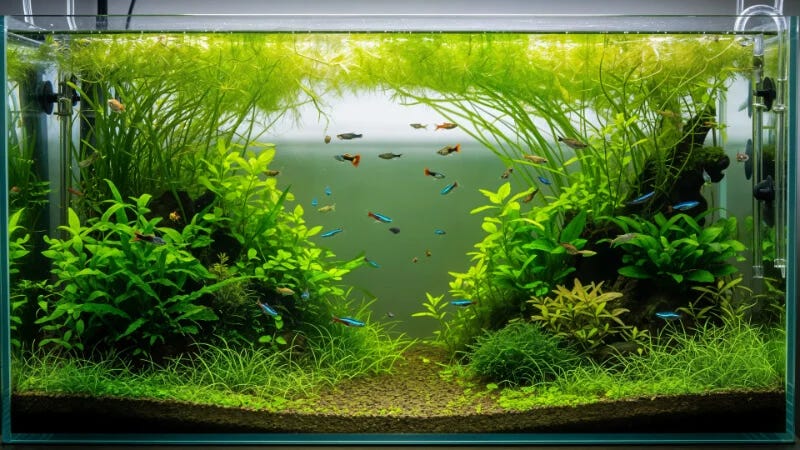
Your Body’s Fish Tank: Biofilm as Inner Algae
One of the metaphors I often use in the bioelectric health model is the body as a fishtank, a living aquarium. It needs oxygen, movement, clean current, proper filtration, and the right microbial ecology. When flow is interrupted, charge drops, oxygenation decreases, and wastes accumulate. The terrain gets swampy. This creates the conditions for biofilm to flourish – the internal equivalent of algae in the tank.
Biofilm is like algae in the sense that both are living communities that grow as a layer on a surface when moisture, nutrients, and time are present. They are not just “gunk”; they are organized ecosystems.
What Biofilm Really Is
Biofilm is not just “bacteria stuck to something.” The microbes produce a sticky protective substance, almost like a self‑made gel or glue, and then live inside it as a community. Algae can also create slick, slimy layers on rocks, tanks, pipes, teeth, ponds, and shower tiles. That slipperiness is often the living community plus its protective coating.
Biofilms are microbes embedded in an extracellular polymeric substance (EPS), a highly hydrated matrix that acts like a shield and makes them much harder to eradicate than free‑floating microbes.
How Biofilm Behaves Like Algae
A few parallels that make this very real:
They both make a slimy matrix.
The slime is not just residue; it is a living, structured layer that the organisms build to protect themselves.They both colonize surfaces.
Algae grows on rocks, glass, docks, ponds, birdbaths, shower tiles. Biofilms grow on teeth, wounds, pipes, medical devices, gut lining, showerheads, water bottles. In both cases, the organisms prefer to attach, spread, and make a little ecosystem rather than just float around freely.They both create a protected micro‑environment.
Once established, the layer shields the organisms inside from drying out, chemicals, antibiotics, immune activity, chlorine, vinegar, brushing, or other disturbances. You can wipe the surface and it comes back if the underlying conditions remain.They both thrive where there is stagnation.
Still water, low circulation, residue, warmth, minerals, sugars, mucus, dead tissue, or organic debris all help these layers grow. Flow and oxygenation tend to discourage stagnant buildup.They can be beneficial or problematic depending on location.
Algae in a pond can produce oxygen and support an ecosystem, but algae in a water line can clog things. Biofilms in soil and some parts of the microbiome can be normal and useful, but biofilms on teeth, implants, wounds, sinuses, or in chronic infections can become protective fortresses for microbes.
The simple image is: biofilm is like microbial pond scum on a surface. It is not a single invader; it is a community, with structure, shelter, communication, and persistence. That is why “killing germs” often does not solve a biofilm problem. You have to disrupt the habitat, break up the matrix, improve flow, reduce residue, and change the conditions that allowed it to root in the first place.
The Inner Algae Message: It’s About Flow, Not Just Germs
The shared principle is this: both excess algae and biofilm are surface‑based living communities protected by a slimy matrix. In the body, the algae model is a helpful metaphor, but the goal is not to nuke the pond. The goal is to restore flow, coherence, terrain integrity, and microbial balance while gently dismantling the protective slime layer that has formed where life got stuck.
Key Levers to Change the Terrain
Think in terms of “cleaning the tank” from the inside out:
Change the terrain.
Less stagnation, better drainage, less sugar and debris, better oxygenation, better elimination. Anything that improves circulation and reduces residue makes your inner waters less hospitable to slime.Mechanically disrupt where appropriate.
Teeth, tongue, sinuses, skin, wounds, mucus — these are places where physical disruption matters. Brushing, flossing, tongue scraping, nasal rinses, gentle exfoliation, and appropriate wound care help break up local slime layers.Use matrix disruptors intelligently.
NAC, enzymes, and certain chelators may have a role, but the form, dose, location, and context matter enormously. The body generally likes steady, respectful support more than sudden shock.Do not just “break it up” without an exit plan.
When biofilm is disrupted, microbes and inflammatory material can be released. That can make people feel worse if elimination, immune capacity, and microbial control are not supported.Avoid the pond‑cleaner mistake.
The body is not a swimming pool, and biofilm is not simply “gunk” to dissolve. It is part chemistry, part microbiology, part terrain, part immune conversation. Quick “cleaners” can stir up more trouble than they solve if the drainage and current are weak.
When fluids move well — blood, lymph, bile, mucus, cerebrospinal fluid, interstitial fluid — the internal terrain stays clearer. When flow slows down, the system gets swampy. Waste lingers. Oxygen drops. Microbial communities shift. Mucus thickens. Bile gets sluggish. The matrix starts to build.
Lymph: The Fish Tank’s Drainage System
What Lymph Does
Lymph is a huge part of this picture. Lymph is the drainage system of the body’s fish tank. It is the slow‑moving fluid that clears the spaces between the cells. It picks up excess fluid, proteins, cellular debris, microbial material, inflammatory byproducts, fats, and information from the tissues and carries them through the lymph nodes for filtering.
In the fish tank metaphor, lymph is what keeps the gravel, corners, plants, filter intake, and glass edges from becoming stagnant. It is the under‑gravel filtration system, the sump pump, and the quiet cleanup crew.
Why Lymph Gets Stagnant
Lymph does not move with the force of the bloodstream, because it does not have a heart‑like pump. It depends on movement, breathing, muscle contraction, pressure changes, stretching, twisting, walking, bouncing, singing, and the wave motion of the body.
This is why lymph stagnation can feel so swampy. It is not always dramatic. It may show up as puffiness, heaviness, tenderness, swollen glands, thickened tissues, cellulite‑like congestion, brain fog, or a sense that the inner waters are not draining well. The tissue spaces become like the corners of a fish tank where the current does not reach.
The lymph nodes are the filters in this metaphor. They are not just passive strainers; they are immune intelligence hubs. They sample what is moving through the fluid and help the body decide what needs to be cleared, neutralized, tolerated, or responded to. In a sense, the lymph nodes are where the water report gets read.
Lymph is the current of the in‑between. It is the fluid field around the cells. If that field is moving, oxygenated, mineralized, and regularly cleared, the cells are living in a cleaner, more coherent stream. If that field slows down, waste accumulates, inflammatory signals linger, proteins collect, tissues swell, and microbes have more opportunity to organize into sticky communities.
Bile: One of Your Great Anti‑Stagnation Fluids
Why Bile Matters for Inner Algae
The bile piece is especially interesting because bile is not just a digestive soap – it is one of the body’s great anti‑stagnation fluids. It is detergent, emulsifier, microbial regulator, waste carrier, lipid conductor, and downstream current. When bile flows well, fats get broken down, wastes move out, the microbiome is regulated, and the internal aquarium stays clearer. When bile stagnates, the terrain gets thicker, stickier, more anaerobic, more sludge‑prone, and more hospitable to biofilm‑like overgrowth.
The liver makes bile, the gallbladder stores and concentrates it, and then the gallbladder releases it into the small intestine when fats and proteins trigger cholecystokinin (CCK). So someone can be “low bile” because the liver is not making enough, because the gallbladder is not squeezing well, because stones or sludge are blocking flow, or because the whole digestive rhythm is weak.
What Decreases Bile Flow or Quality
Liver strain.
Fatty liver, toxins, certain medications, inflammation, and metabolic stress can reduce bile synthesis or secretion.Gallbladder stagnation.
If bile sits too long, it can thicken into sludge or form stones, which can block ducts and slow or stop flow.Meal patterns that lack rhythm and fat.
Skipping meals, long aggressive fasting, or very low‑fat eating mean the gallbladder gets fewer signals to contract. The fish tank equivalent is “the pump doesn’t turn on often enough.”Weak digestive signaling.
Tiny, rushed, low‑fat meals eaten under stress may not send a strong “bile, please” message to the system.Thyroid sluggishness.
Low thyroid function is associated with more gallbladder and bile duct issues, partly through effects on cholesterol metabolism and motility.Microbiome disruption.
Bile and microbes are in constant conversation. When the microbiome is disturbed, bile metabolism and flow can be disturbed too.
Practical Ways to Restore Bile Flow
Everyday Actions That Move the Inner Current
Eat regular meals with some real fat.
Not huge fatty meals, especially if the gallbladder is tender, but enough healthy fat to give the gallbladder a reason to contract: eggs, olive oil, avocado, butter/ghee if tolerated, fatty fish, nuts, seeds, meat with its natural fat. A totally fat‑free diet can deprive the system of the very signal that moves bile. Also, chew thoroughly.Do not fast aggressively if bile is stagnant.
Fasting can be useful for some things, but for someone prone to sludge, stones, constipation, or fat malabsorption, long fasting windows can mean bile sits around too long.Increase bitter foods before meals.
Arugula, dandelion greens, radicchio, endive, parsley, lemon, a little apple cider vinegar if tolerated, artichoke, ginger, bitter tinctures. Bitters tell the system, “Get ready, digestion is coming.”Hydrate and mineralize.
Thick fluids are often under‑hydrated fluids. Bile is a fluid. Lymph is a fluid. Mucus is a fluid. The whole internal aquarium needs water and electrolytes, not just “detox” herbs.Move the body.
Walking, twisting, bouncing, breathing, belly massage, using a weighted tuning fork on tight areas, stretching the diaphragm and ribs — all of this supports the mechanical movement of liver, gallbladder, lymph, bowel, and vagal tone. Bile is not just chemistry; it is also hydraulics.Reduce refined sugar and constant snacking.
Refined carbs and sugar are associated with more gallbladder issues, and constant grazing can blur the digestive rhythm. The gallbladder likes a clear signal: food arrives, bile releases, digestion completes, the system resets. Ensure adequate protein and fat.Be cautious with “gallbladder flushes.”
If someone has stones, sludge, duct narrowing, or right‑upper‑quadrant pain, aggressive bile stimulation can make things worse. The goal is not to blast open the plumbing; it is to restore intelligent, gradual flow.
Emotional and Biofield Dimensions
In many traditional frameworks, the liver is associated with the emotion of anger, and in the Biofield Anatomy model, it also holds the energy of our father and our relationship with them. This mapping is energetic rather than anatomical, but growing up with a challenging father or father figure can create deep subconscious tension in the liver and gallbladder region. That tension can inhibit the function of these organs.
Biofield Tuning is one approach that can be useful for relaxing that tension and helping the body let go of old emotional charge. When the energy of the organ softens, better physical function often follows. The Sonic Slider tuning fork is also a helpful tool for stimulating tissues into improved functioning.
Bringing It Back to Your Inner Fish Tank
In fish tank language: feed the fish properly, keep the pump running, clean the filter, oxygenate the water, don’t overfeed the tank, and don’t let the green slime take over the glass.
In body language: nourish mindfully and not excessively, foster digestive fire, restore filtration, breathe and move, and keep the current clear so biofilm has fewer places to root and more reasons to dissolve. When you picture your inner algae and actively support flow, you are already taking powerful, practical steps toward a cleaner, more coherent internal stream.

Learn more about my 3 decades of exploration and discovery with tuning forks here
and my work with voice as a pathway to health here
Great article. Yes pathways of elimination must be flowing when detoxing so important.
I do my own way of fasting. Intuitive since a kid really. I am now fasting in my own way-my only meal today had some 4 pasture raised eggs, a handful of local micro greens with a splash of apple cider vinegar and EVO, and a dash of fermented daikon radish Kim chi.
Interesting that according to Bio-field anatomy- Liver/GB are connected to father. I understand the anger part from TCM. This all makes me think of Candace Pert- molecules of emotion, Louise Hay - you can heal your life, TCM, Ayurveda, and GNM.
Will have to go back to your book read and read more of them. I want to understand how you came up with what you did in Biofield Anatomy with the connections and meanings.
I love using raw silk gloves for dry brushing along with tongue scraping, oil pulling.
High fat diet and high protein is very important for me thrive.
My brain needs it. If I eat high carb I get so ill. And plant based did me so wrong. Part of my falling apart.
Confluence needs more fat in the meals. Next time I will just bring my own and add it to my meals. Like I did with salt! 😄
Eileen:
I agree regarding both the functions of the lymphatic system and bile. I will add that a hyperbaric chamber improves oxygenation, and nattokinase improves circulation. Do not source nattokinase from China; source it from Japan (far superior).